1858 – 1932
BipinChandraPal
The voice that helped turn nationalism into a movement of ideas.
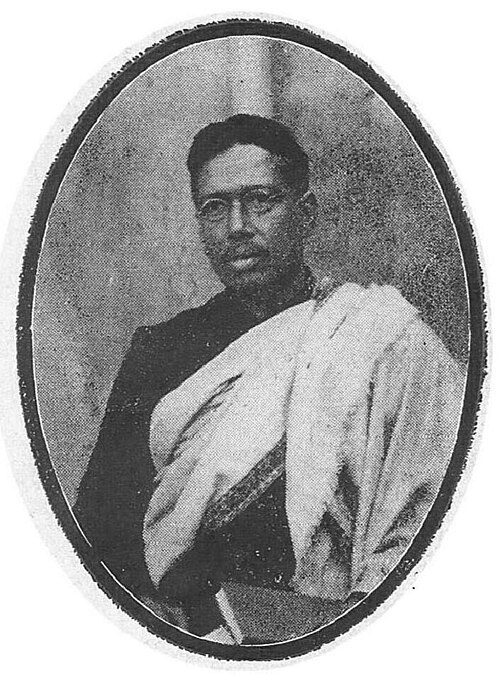
- Born
- 7 November 1858 · Poil, Sylhet
- Died
- 20 May 1932 · Calcutta
- Trade
- Editor, writer, orator
- Founded
- Bande Mataram, 6 Aug 1906
- Known for
- Swadeshi · Swaraj · National education
The Pal Index
Who was Pal?
Most Indians meet Bipin Chandra Pal as a syllable. He is the third beat of a phrase — Lal, Bal, Pal — learned in a classroom, recited in an examination, and rarely opened again. The phrase is accurate. It is also, on its own, close to useless. It tells you that three men were grouped together by their contemporaries. It tells you nothing about what any of them actually did.
What Pal did, for roughly fifty years, was write and speak. He edited newspapers in Bengali and in English. He founded them, ran out of money, and founded more. He wrote books on religion, economics, social reform and constitutional theory. He lectured to audiences of thousands on a Madras beach and to Unitarian congregations in English chapels. When the colonial government put his own newspaper on trial for sedition, he refused to give evidence against its editor and went to prison for six months rather than take the oath.
This is a different kind of political life from the one Indian public memory usually rewards. Pal did not lead an army, sign a treaty or head a government. His instrument was the printed page and the public platform, and his argument was that a nation which could not think for itself would never be able to govern itself. He belongs to the history of Indian nationalism, but he equally belongs to the history of Indian journalism, Indian political theory and Indian education.
The purpose of this publication is straightforward: to read Pal as he actually worked. Not as one third of a slogan, but as a writer whose ideas were themselves a form of political action — and whose arguments about self-reliance, economy, education and the meaning of freedom are recoverable, because he published them, and because a great deal of what he published survives.
Poil, Habiganj, Sylhet district, Bengal Presidency — today in Bangladesh
Three words are not enough.
LalPunjab
BalMaharashtra
PalBengal
Contemporaries used the phrase because the three men argued for the same turn in Indian politics at the same moment. It was shorthand, not a biography. Expand the last syllable and a whole working life opens up.
- Journalist
- Editor
- Thinker
- Orator
- Nationalist
- Writer
- Educator
- Social reformer
- Lecturer
- Librarian
- Headmaster
- Memoirist
Every one of those words is documented in his own publications or in the record of institutions he worked for. None of them appears in the phrase people remember.
The world that made him
Pal was born a year after the uprising of 1857, into a Bengal that was being remade by print, law, English education and religious reform at the same time. He did not invent the conditions of his politics. He inherited them, and then argued with them.
The press
as a weapon
Pal's career is unintelligible without the newspaper. He was not a politician who happened to write. He was a working editor whose politics were conducted, week after week, in columns of type.
Under colonial rule Indians were excluded from the machinery of the state. They could not vote it out, staff its upper reaches, or legislate through it. What they could do — until the law was tightened against them — was print. A newspaper could carry an argument from Calcutta to Madras in a week. It could give a scattered readership the experience of holding an opinion in common. It could turn a local grievance into a national fact.
That is what political journalism did in India before mass politics existed, and it is why the colonial state took the press so seriously. Presses were prosecuted, securities forfeited, editors jailed. When Pal launched the English daily Bande Mataram on 6 August 1906, he did so with roughly five hundred rupees. Within a year the paper was on trial for sedition.
Posterity will judge between him and the petty tribunal.
Sri Aurobindo, on Pal's imprisonment
“The Martyrdom of Bipin Chandra”, Bande Mataram, 12 September 1907
Editorial
Argument, not reportage
The nationalist paper's core product was the leading article. Its job was to supply readers with a position and the reasoning behind it — a political education delivered daily.
Politics
A public that could not vote
Print substituted for the franchise. Readers who had no ballot could still be constituted as an opinion, and an opinion could be counted, quoted and feared.
Economy
The economic case
Pal used the press to argue economics: tariffs, consumption, indigenous industry. Swadeshi reached most people first as a printed argument, not as a purchase.
Censorship
The state reads too
Sedition law, press securities and, after 1908, tightened statutory powers made editing a nationalist paper a legally hazardous occupation. Pal was jailed for six months.
Swadeshi
was more than
a boycott.
The word means “of one's own country”. In popular memory it has shrunk to a shopping instruction: buy Indian goods, burn foreign cloth. Pal's Swadeshi was considerably larger and considerably more demanding.
In his Madras lectures of May 1907 he argued that the boycott of British goods was not a gesture of anger but an economic policy — a tariff imposed by a people on themselves because they had no state to impose one for them. He linked it to indigenous production, to national education, to co-operative organisation in villages, and to the training of a population in the practical habits of self-government.
Swadeshi, on this reading, was a programme for building the capacities of self-rule before self-rule arrived. That is a far harder proposition than a consumer campaign, and it is the reason the movement produced schools, workshops and arbitration committees as well as bonfires.
The event
The Partition of Bengal
Announced under Viceroy Lord Curzon and brought into effect on 16 October 1905, the partition split the Bengal Presidency into two administrative units. Bengali opinion read it as a deliberate attempt to break the province's political weight. Protest meetings, petitions and a boycott of British goods followed.
The idea
Why a border became an argument about economics
Pal's response moved past the map. If an administration could redraw a people at will, then petitions addressed to that administration were the wrong instrument. The alternative was to build capacity outside it — production, schooling, organisation — so that political dependence had a material floor removed from under it. The boycott was the visible edge of that argument, not its content.
It is not in the power of any Government, much less is it in the power of an alien Government, to divide a people whom Gods united.
Bipin Chandra Pal, “The New Movement”
Speeches Delivered at Madras, Ganesh & Co., 1907
Lal · Bal · Pal
They were not a party, an organisation or a committee. They were three regional political energies that converged — and did not always agree.
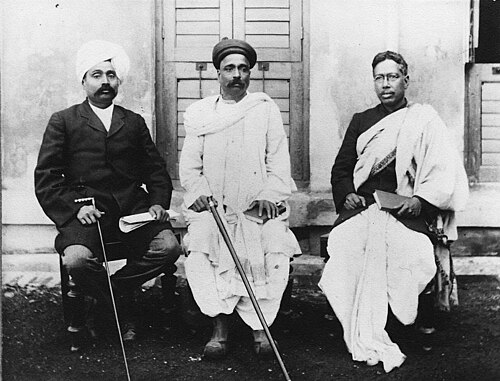
By 1905 the Indian National Congress contained two temperaments. One held that British rule could be reformed by petition, argument and constitutional pressure. The other held that it would concede nothing that was not made costly to withhold.
Lajpat Rai in Punjab, Tilak in Maharashtra and Pal in Bengal belonged to the second temperament. Because they pressed the same case simultaneously in three provinces that rarely acted together, contemporaries began naming them as a unit. The phrase stuck because it described a real convergence — the moment provincial politics became national politics.
It should not be mistaken for a shared programme. Tilak's political idiom drew on Maharashtrian religious and civic tradition; Lajpat Rai's on the Arya Samaj and Punjabi organisational work; Pal's on Brahmo reform, Bengali print culture and a strongly economic reading of colonial rule. They differed on tactics, on religion in politics, and later on the Congress itself.
Compare the three in detail — including where the record shows them disagreeing.
Punjab
Lala Lajpat Rai
1865 – 1928
Organiser, writer and Arya Samaj reformer. Deported without trial in 1907. Later led the protest against the Simon Commission at which he was injured, shortly before his death.
Maharashtra
Bal Gangadhar Tilak
1856 – 1920
Editor of Kesari and The Mahratta. Built mass political feeling through public festivals and the vernacular press. Imprisoned for sedition; sentenced in 1908 to six years' transportation to Mandalay.
Bengal
Bipin Chandra Pal
1858 – 1932
Editor, lecturer and theorist. Founded Bande Mataram in 1906. Argued the economic and educational case for Swadeshi more systematically than either colleague, and wrote at book length on the constitutional question.
Words can
organize people.
In a society with low literacy and no broadcast media, the public meeting was the mass medium. Pal was among its most effective practitioners — and, unusually, a large body of his spoken work survives in print.
Between 2 and 9 May 1907 he delivered a series of six lectures in Madras. They were taken down, printed and published the same year by Ganesh & Co. Because that volume survives, we can read what he actually said rather than what was later attributed to him.
The six subjects were: The New Movement; The Gospel of Swaraj; Swaraj: Its Ways and Means; Boycott; The Contribution of Islam to Indian Nationality; and National Education. That fifth title matters. Speaking at the invitation of a Young Men's Mahomedan Association, Pal argued that Indian nationality was composite by constitution — not a Hindu inheritance with others admitted as guests.
Of all kinds of despotism, a benevolent despotism is the worst, because the benevolence makes people acquiesce in the despotism.
Bipin Chandra Pal, Madras lectures, May 1907
Speeches Delivered at Madras, Ganesh & Co., 1907
The argument is precise: good administration is not a substitute for self-government, and may be its most effective obstacle, because it removes the friction that produces political consciousness.
What he actually argued
Pal's positions changed across fifty years. Reading them as a fixed doctrine flattens him; reading them in sequence shows a mind revising under pressure of events.
On freedom. Pal distinguished sharply between good government and self-government, and insisted that the second was not a reward for deserving the first. Freedom, in his account, was the condition under which a people learns to govern — not a certificate issued once it has proved it can.
On economy. He treated colonial rule as an economic arrangement before a political one. Boycott, in his 1907 formulation, was a protective tariff a people levied on itself in the absence of a state that would levy one for them — an argument he made in explicitly economic language.
On education. His sharpest writing attacks an education that trained Indians in an English world and left them illiterate in their own. His image for it was botanical: pupils taught the oak and the elm while ignorant of the banyan outside the classroom window.
On composite nationality. Against a narrowly Hindu nationalism, Pal argued that Indian nationality was formed by more than one civilisational inheritance, Islam among them, and that a national movement which forgot this would fail on its own terms.
On social reform. Formed by the Brahmo Samaj, he opposed caste restriction and supported widow remarriage — and married a widow himself. He held that a society unwilling to reform its own hierarchies would not sustain political freedom.
On the constitution of India. In later works he engaged directly with questions of federation, responsible government and the relationship between India and the Empire, publishing on these at book length between 1916 and 1922.
The cost of politics
Opposition under colonial rule was not costless, and the costs were mostly administered through law.
The state's instruments were prosecution, forfeiture of press securities, deportation without trial, and imprisonment. In 1907 Lala Lajpat Rai was deported without charge; in 1908 Tilak was sentenced to six years' transportation for sedition. Pal's own turn came in September 1907, when he was called as a prosecution witness against the editor of the newspaper he had founded.
He refused to take the oath. He stated a conscientious objection to taking any part in the prosecution, and was sentenced to six months' imprisonment. He was released in March 1908, to public demonstrations.
The costs were not only legal. His London journal Swaraj collapsed in 1909. His finances did not recover easily, and the last stretch of his life was spent largely outside the organisation he had helped to radicalise. Political consequence, in his case, was cumulative rather than dramatic.
The event
September 1907: six months
Summoned as a witness for the Crown in the sedition prosecution arising from Bande Mataram, Pal declined to give evidence. The court treated the refusal as contempt and imprisoned him for six months. He was released in March 1908.
The idea
What a refusal establishes
Pal's refusal was not a legal defence; he had none. It was a claim that a subject population owes a colonial court obedience but not collaboration — that there is a difference between submitting to a law and lending it your voice. The distinction between legal duty and moral obligation under an unrepresentative state became one of the reference points of nationalist argument.
Written for classroom use. This site describes repression factually and does not use distressing imagery.
What survives?
Pal died on 20 May 1932 in Calcutta, fifteen years before the independence he had spent his life arguing for. He held no office. He founded no lasting institution bearing his name. By the standards a nation usually uses to measure its founders, he left very little.
What he left instead was text. His Madras lectures were printed in 1907 and are readable today. The Soul of India (1911), Nationality and Empire (1916), Responsible Government (1917), Non-co-operation (1920) and Swaraj: What Is It? And How to Attain It (1922) are catalogued in research libraries. His memoir, Memories of My Life and Times, was published in Calcutta in 1932, the year he died.
That is a specific kind of survival. A speech is an event and ends; a printed speech is an argument and does not. The reason Pal can be read at all, more than a century later, is the same reason he mattered at the time: he committed his politics to print, and print outlasted both him and the government he opposed.
In 1958, on the centenary of his birth, the Government of India issued a fifteen-naya-paisa stamp bearing his portrait and the words Scholar & Patriot. It is a modest object. It is also, in a country that names airports after its politicians, an oddly appropriate one for a man whose instrument was a printed sheet.
1906
Bande Mataram founded, 6 August
6
Madras lectures, May 1907
6
Months imprisoned, 1907–08
1958
Commemorative stamp, birth centenary
Principal sources for this page
- Bipin Chandra Pal, Speeches of Bepin Chandra Pal, Delivered at Madras (Madras: Ganesh & Co., 1907). Digitised full text, Internet Archive. Quotations transcribed from the printed volume.
- Sri Aurobindo, “The Martyrdom of Bipin Chandra”, Bande Mataram, 12 September 1907; collected in Bande Mataram: Political Writings and Speeches 1890–1908.
- Editorial note on the founding and editorship of the Bande Mataram daily, in Bande Mataram: Political Writings and Speeches 1890–1908 (Sri Aurobindo Ashram).
- “Pal, Bipin Chandra”, Banglapedia: National Encyclopedia of Bangladesh.
- Catalogue records for Pal's published works, The Online Books Page, University of Pennsylvania Libraries.
- India Post commemorative stamp record, birth centenary issue, 7 November 1958.
Where accounts differ — for example on the exact year Pal took charge of individual periodicals — the disagreement is stated on the relevant page rather than resolved silently.