The triumvirate
Lal
Bal
Pal
Three men, three provinces, one turn in Indian politics — and a set of disagreements the phrase conceals.
Comparison
Where the phrase came from, and what it hides
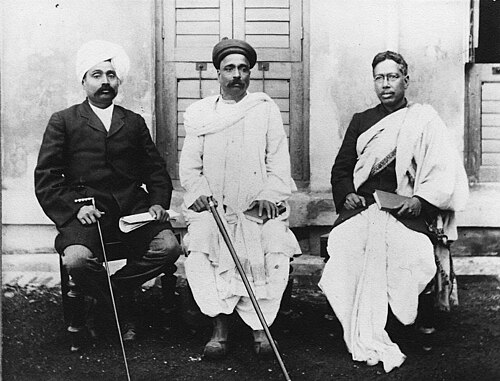
“Lal–Bal–Pal” is a contemporary coinage: a rhyme made from three surnames, used because the three men were pressing the same case at the same time in three provinces that rarely acted in concert.
That is a real historical fact and it deserves respect. Indian nationalism before 1905 was strikingly provincial. Punjab, Maharashtra and Bengal had distinct political cultures, languages, reform movements and grievances. The significance of the trio is that for a few years those cultures pointed the same way at once, and Indians in each province could see it happening.
But the phrase does two kinds of damage. It suggests a partnership — a committee, a manifesto, an agreed programme — that never existed. And it flattens three very different intellectual formations into one label, which is particularly costly for Pal, whose distinctive contribution was theoretical and is precisely what a rhyme cannot carry.
This page treats the three as what they were: allies of temperament and moment, differing in method, differing in the place they gave religion in politics, and eventually differing about the Congress itself.
Three provinces
Each man drew on the political resources his own region actually had.
Punjab — Lal
Lala Lajpat Rai
1865 – 1928
Lawyer, writer and organiser, formed by the Arya Samaj — a Hindu reform movement with a strong institutional and educational programme. His political base was built through associations, schools and relief work rather than through a mass festival culture.
Deported without trial to Burma in 1907 during the agrarian unrest in Punjab. Decades later he led the protest against the Simon Commission at Lahore, was injured in a police action, and died shortly afterwards in 1928.
Maharashtra — Bal
Bal Gangadhar Tilak
1856 – 1920
Scholar, mathematician and editor of Kesari (Marathi) and The Mahratta (English). He built political feeling through public festivals and the vernacular press, reaching a far wider social range than the professional classes the Congress usually spoke to.
Prosecuted for sedition more than once; in 1908 sentenced to six years' transportation and imprisoned at Mandalay. Later a founder of the Home Rule movement.
Bengal — Pal
Bipin Chandra Pal
1858 – 1932
Editor, lecturer and theorist, formed by the Brahmo Samaj and by Bengal's dense periodical culture. He worked in English and Bengali, and his politics were conducted principally through argument in print and from the platform.
Founded Bande Mataram in 1906. Imprisoned for six months in 1907 for refusing to testify. Alone among the three, he published systematic book-length work on nationality, economy and responsible government.
Compared directly
| Lala Lajpat Rai | Bal Gangadhar Tilak | Bipin Chandra Pal | |
|---|---|---|---|
| Region | Punjab | Maharashtra | Bengal (born in Sylhet) |
| Lived | 1865–1928 | 1856–1920 | 1858–1932 |
| Religious formation | Arya Samaj | Orthodox Brahmin background; drew on Maharashtrian religious tradition in public politics | Brahmo Samaj — reformist, anti-caste, comparative in method |
| Principal instrument | Organisation, education, writing, relief work | The vernacular press and mass public festival | The newspaper and the lecture platform |
| Newspapers | Wrote extensively; associated with several publications | Kesari, The Mahratta | Paridarshak, The Tribune, New India, Bande Mataram, Swaraj |
| State action against | Deported without trial, 1907 | Sedition conviction, 1908; six years' transportation to Mandalay | Six months' imprisonment, 1907, for refusing to testify |
| Distinctive emphasis | Institution-building and the organisational base of nationalism | Mass participation, and the claim that Swaraj is a birthright | The economic and educational theory of self-reliance; composite nationality |
| Later trajectory | Remained central to Congress politics until his death in 1928 | Home Rule movement; died 1920, as Gandhi's leadership began | Increasingly at odds with Congress direction after 1920; withdrew from active politics |
What they genuinely shared
Four positions, held in common, which is what made the phrase meaningful in the first place.
Where they differed
Treating the three as interchangeable is the commonest error made about them. The record does not support it.
On religion in politics. This is the sharpest difference. Tilak's political idiom drew on Maharashtrian Hindu tradition, and Lajpat Rai's on the Arya Samaj. Pal came from the Brahmo Samaj, a movement defined by its rejection of image-worship and caste, and he argued explicitly for a composite Indian nationality. In his fifth Madras lecture of 1907 — delivered at the invitation of a Young Men's Mahomedan Association — he took as his subject the contribution of Islam to Indian nationality. Banglapedia records that although he was influenced by the extremist leaders, he championed “composite patriotism” rather than narrow Hindu nationalism.
On the pace of confrontation. Pal was pushed out of Bande Mataram in November 1906 because those around Aurobindo wanted a more openly revolutionary line than he was prepared to publish. In his Madras lectures he insisted repeatedly that the movement must keep strictly within the law and place its opponents in the wrong. That is not the position of a man seeking insurrection.
On social reform. Pal's Brahmo formation made caste and the position of women political questions. He married a widow at personal cost, and he wrote on social reform throughout his life. The other two prioritised differently.
On the Congress after 1920. The clearest divergence came at the end. Tilak died in 1920. Lajpat Rai remained a central Congress figure until 1928. Pal opposed the direction Gandhi took the Congress, published four lectures against non-co-operation in 1920, and spent his last years largely outside the organisation.
Surat, 1907
The Indian National Congress met at Surat in December 1907 and broke apart.
The division was between the wing that held to constitutional petition and the wing that wanted the Congress committed to Swadeshi, boycott and national education as standing policy. The session collapsed in disorder and the two groups separated; they would not reunite for nearly a decade.
The split is usually narrated as a disaster, and in organisational terms it was. But it also clarified something. Until Surat, the Congress could contain both positions by declining to specify what it wanted. Afterwards it could not. The question of whether Indian nationalism was a petitioning association or a movement had been forced into the open.
Pal's own year had already been consumed by it: the Madras lectures in May, the sedition prosecution of his former paper in the summer, prison from September. He came out in March 1908 into a movement that had fractured and a government with new powers over the press.
What Pal contributed that the others did not
If the three are read together, Pal's distinctive function becomes visible: he was the one who explained the movement to itself.
Tilak's genius was reach — he found forms that carried politics to people the Congress had never spoken to. Lajpat Rai's was organisation — institutions, schools, associations, structures that outlived any particular agitation.
Pal's was argument. He is the member of the trio who set out, in printed and reproducible form, why boycott was economically defensible, why good government was not self-government, why a national education system was structurally necessary rather than symbolically desirable, and why Indian nationality had to be understood as composite. His Madras lectures of 1907 are, in effect, a course in the theory of the movement, delivered over eight days and printed the same year.
That is also why he is the least remembered. Reach and organisation leave monuments. Argument leaves books, and books have to be opened.
Read the argument itself in Political Thought, or the education case in National Education.
Of all kinds of despotism, a benevolent despotism is the worst.
Bipin Chandra Pal, Madras, May 1907
Speeches Delivered at Madras, Ganesh & Co., 1907
Sources for this chapter
- Bipin Chandra Pal, Speeches of Bepin Chandra Pal, Delivered at Madras (Ganesh & Co., 1907) — including the fifth lecture, “The Contribution of Islam to Indian Nationality”.
- “Pal, Bipin Chandra”, Banglapedia — on Pal's advocacy of “composite patriotism” rather than narrow Hindu nationalism.
- “Note on the Texts”, Bande Mataram: Political Writings and Speeches 1890–1908 — on Pal's departure from the paper in November 1906 and Aurobindo's arrest on 2 May 1908.
- Standard reference accounts of Lala Lajpat Rai and Bal Gangadhar Tilak for dates, deportation, sedition conviction and later careers.
- Catalogue records, The Online Books Page, University of Pennsylvania Libraries — for Pal's Non-co-operation: Four Lectures (1920).